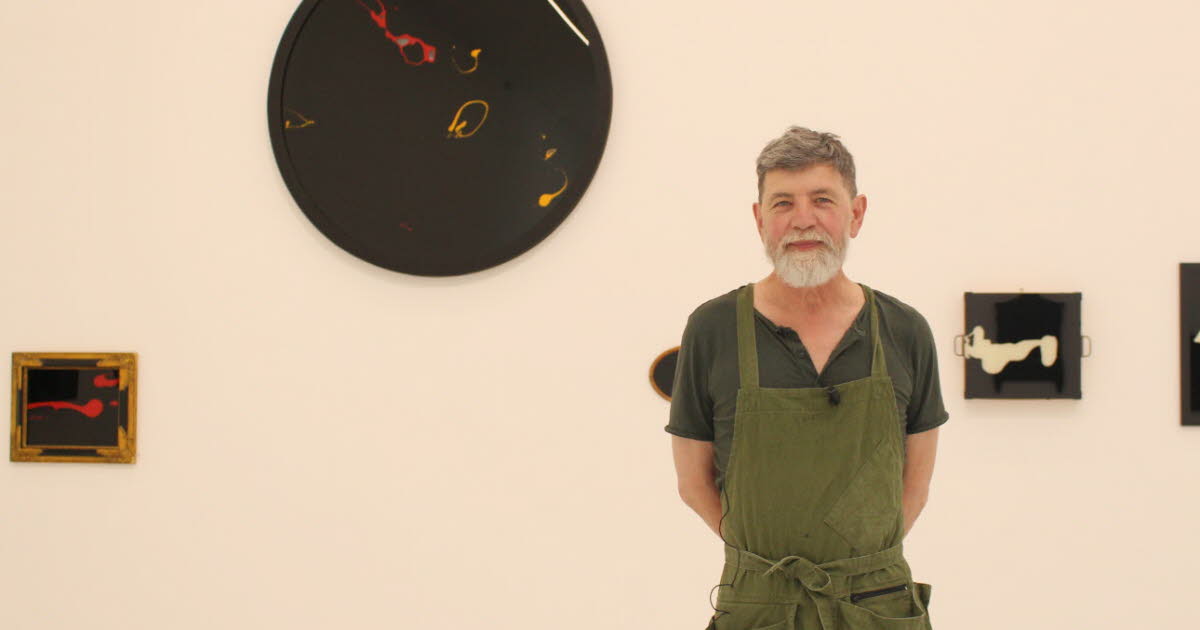
The art world is mourning the sudden and tragic loss of Philippe Favier, a distinguished French painter renowned for his intricate, often minuscule, works. Favier passed away at the age of 68 in a devastating car accident on March 7. His untimely death has sent ripples of sadness through the artistic community, marking the end of a singular career that defied conventions and captivated audiences worldwide.
Favier, a native of Saint-Étienne, was on his way home to Nice from his studio in Châteaudouble, a village in the Var region of France, when the fatal accident occurred. His passing leaves behind a legacy of unique artistry, characterized by an almost obsessive attention to detail and an imaginative use of unconventional materials. While "Le Monde" newspaper highlighted his "absolute singularity," the general media response to this significant loss was surprisingly muted, perhaps due to the weekend timing of the announcement. Nevertheless, his impact on contemporary art is undeniable, and his distinctive voice will be sorely missed.
The Tragic End of a Singular Vision: Philippe Favier's Fatal Accident
The news of Philippe Favier's death in a car accident on March 7, at the age of 68, came as a shock to those familiar with his work and his vibrant presence in the art scene. The renowned artist was reportedly en route from his creative sanctuary in Châteaudouble, located in the picturesque Var region, to his residence in Nice when the fatal incident occurred. This sudden end to a prolific career underscores the fragility of life and the unpredictable nature of fate, silencing an artistic voice that consistently challenged norms.
For decades, Favier had chosen the sun-drenched south of France as his home and inspiration, a departure from his industrial hometown. The journey between his studio and home, a familiar route, became the setting for this profound tragedy. While the immediate details of the accident remain largely private, the profound impact of this loss resonates deeply within the artistic circles he inhabited. The passing of an artist of Favier's calibre is always a moment of reflection, prompting us to revisit their contributions and consider the void they leave behind. The unfortunate lack of widespread immediate media attention doesn't diminish the significance of the event for those who appreciated his distinct artistic journey, prompting a deeper dive into the life and work of this remarkable individual.
From Haberdashery to High Art: Favier's Unconventional Path
Born in Saint-Étienne on June 12, 1957, Philippe Favier's early life experiences profoundly shaped his artistic sensibilities. As an only child, he spent countless hours playing alone, fostering a vivid imagination fueled by the two magical worlds his parents cultivated. By day, they ran a bustling haberdashery, a treasure trove of ribbons, buttons, threads, and fabrics. By night and on weekends, they managed a vibrant dance hall, exposing young Philippe to a different kind of spectacle and rhythm. This unique blend of meticulous craft and lively performance undoubtedly seeped into his subconscious, providing a rich, often whimsical, foundation for his later work.
Favier's early academic journey was, by his own admission, somewhat challenging; he was "refractory to the school system." This independent spirit, however, proved to be a strength rather than a weakness. Before enrolling in the Beaux-Arts in Saint-Étienne in 1979, he explored various professions, including a stint as a press cartoonist in 1977 and even working as a psychiatric nurse. These diverse experiences, far from being detours, offered him unique perspectives on human nature and the world, enriching his artistic vocabulary. His entry into the Beaux-Arts proved fortuitous, placing him under the guidance of influential figures like Bernard Ceysson, who would later become a renowned museum director, and Daniel Abadie, who would curate Favier's work at the prestigious Jeu de Paume in 1996. It was here that Favier began to forge his unique identity, departing from the conceptual art prevalent at the time to embrace his distinctive "minuscule" aesthetic. This period of exploration and self-discovery ultimately led him to become a revered figure in the art world, as explored further in Philippe Favier: From Saint-Etienne to Global Art, A Sudden End.
The Master of the Minuscule: Favier's Unique Artistic Legacy
Philippe Favier carved out a distinctive niche in the art world, becoming known as "the man of the minuscule" at a time when monumental art often dominated. His signature style involved creating incredibly small, intricate drawings, often executed with a simple pen on paper. These miniature figures were then meticulously cut out and pinned directly onto walls, creating sprawling, fragmented narratives that invited viewers to lean in, observe closely, and discover a world within worlds. This direct, almost tactile, presentation became a hallmark of his exhibitions.
His artistic process was deeply informed by his childhood experiences in the haberdashery. Much like his parents utilized a myriad of materials, Favier was an ingenious recycler and assembler. He famously appropriated an astonishing array of found objects and surfaces as foundations for his work: old geographical maps, archival documents, photographs, pebbles, shards of glass, and even empty sardine cans. This Stakhanovite approach to creation resulted in an immense body of work, a testament to his prolific imagination and tireless dedication. Favier's art was not merely about smallness; it was about the profound impact that detail and unexpected juxtapositions could have. His works were often described as simultaneously cultivated, humorous, and fantastical, weaving complex stories from fragmented elements. One notable example is his monumental "Géographie à l’usage des gauchers" (Geography for Left-Handers), created during his year-long residency at the MAC Lyon in 2004, which showcased his ability to scale his intricate vision to grand proportions without losing its intimate charm.
A Global Footprint, a Modest Spirit: Philippe Favier's International Recognition
Despite his singular and often understated artistic approach, Philippe Favier quickly garnered significant recognition, both in France and internationally. His career took off rapidly, starting with early exhibitions in Saint-Étienne, where Bernard Ceysson, by then the director of the city's new Museum of Modern Art, became an early champion. From there, his work traveled across France and eventually around the globe. Major art centers like Tokyo and New York began to appreciate his distinctive vision, leading to exhibitions that solidified his international standing. He collaborated with prestigious galleries, including Yvon Lambert in Paris and Guy Bärtschi in Geneva, further cementing his place in the contemporary art scene.
Official institutions also recognized his talent; Favier was commissioned twice to work for the prestigious Sèvres porcelain manufacture, showcasing his versatility and ability to translate his aesthetic into different mediums. His connection to Geneva was particularly strong and enduring, with the city retaining several of his pieces, notably his engravings, a technique he explored with great skill. Yet, despite this widespread acclaim and his presence in significant collections, Favier remained remarkably modest and "inclassable," known for his gentle humor and unassuming demeanor. His works, while widely appreciated, rarely commanded the "fabulous prices" often associated with globally recognized artists, perhaps a reflection of his own unpretentious spirit and the intimate nature of his art. However, their true value lay in their absolute originality and the unique perspective they offered on the world. To learn more about his impact, read Remembering Philippe Favier: The Master of Miniature Art.
The tragic car accident that claimed Philippe Favier's life at 68 leaves a void in the contemporary art landscape. His singular vision, born from a childhood steeped in the tactile wonders of a haberdashery and the rhythm of a dance hall, developed into an artistic language that was both deeply personal and universally resonant. As the "man of the minuscule," he taught us to find grandeur in the small, narrative in the fragmented, and beauty in the everyday. His legacy is not just in the vast collection of his intricate drawings and assemblages, but in the inspiration he provides to artists and viewers alike to look closer, think differently, and embrace one's unique path. Though he may be gone, Philippe Favier's art will continue to whisper its profound, intimate stories for generations to come, reminding us of the extraordinary vision that ended far too soon.